

96: Melos, Might & Right
Following the Battle of Mantinea in 418 BC, the balance of power in Greece shifts once again as Sparta restores its dominance and Athens faces a growing crisis of confidence. In this episode, we explore the political struggles between Nicias and Alcibiades, the final use of ostracism in Athens, and the collapse of the fragile peace between the rival powers. We examine the conquest of Melos in 416 BC and the famous Melian Dialogue recorded by Thucydides, exploring the themes of power, empire, morality, and the consequences of Athenian imperial ambition. As Athens moves toward its next great challenge, the seeds of the disastrous Sicilian Expedition are planted.

97. Sicily, Deciding Disaster
The Sicilian Expedition of 415 BC was the most ambitious military undertaking of the Peloponnesian War and a decision that would forever alter the course of Athenian history. In this episode, we explore why Athens chose to invade Sicily, beginning with Segesta’s appeal for assistance and the fierce debate between Nicias and Alcibiades over the risks and rewards of intervention. We examine how political ambition, imperial confidence, and strategic calculation transformed a limited mission into a massive invasion force. Drawing on the accounts of Thucydides and other ancient sources, we consider whether the expedition was doomed from the outset or whether a series of political decisions and unforeseen events turned one of history’s boldest campaigns into Athens’ greatest catastrophe.

98: Launch of the Sicilian Expedition
The Sicilian Expedition begins as Athens launches the largest naval armada ever assembled by a Greek city during the Peloponnesian War. In this episode, we follow the expedition from its approval in the Athenian Assembly to the dramatic departure from the Piraeus, examining the political debates, logistical challenges, and competing strategies of Nicias, Alcibiades, and Lamachus. We also explore the shocking mutilation of the Herms, the controversy surrounding the Eleusinian Mysteries, and the accusations against Alcibiades that threatened the expedition before it had even reached Sicily. As Athens searches for allies and discovers Segesta’s promises were greatly exaggerated, the reality of the campaign begins to replace the optimism that launched it.

99: The Arrival in Sicily
The Sicilian Expedition enters its critical opening phase as Athens arrives in Sicily to confront Syracuse in 415 BC. In this episode, we examine the challenges facing the Athenian invasion, from the disappointing support offered by the cities of Magna Graecia to the revelation that Segesta’s wealth had been greatly exaggerated. We explore the competing strategies of Nicias, Alcibiades, and Lamachus, the dramatic recall and defection of Alcibiades to Sparta, and Syracuse’s preparations under Hermocrates. Finally, we follow the first Battle of Syracuse, where Athenian deception secured an important victory but failed to deliver the decisive result needed to end the campaign. With both sides adapting their strategies, the stage is set for a prolonged struggle that would reshape the Peloponnesian War.

100: Sicily, The Hard Road Ahead
The Siege of Syracuse enters a decisive new phase as Athens transforms an early battlefield victory into a campaign of siege warfare. In this episode, we examine Nicias’ preparations for a prolonged siege, the military reforms introduced by Hermocrates, and the diplomatic efforts that drew Corinth and Sparta into the conflict. We also explore Alcibiades’ arrival in Sparta, where his strategic advice led to the dispatch of Gylippus to Sicily and the fortification of Decelea in Attica. Finally, we follow the Athenians’ bold capture of the Epipolae Heights, a critical strategic position that brought Syracuse to the brink of encirclement before Spartan intervention threatened to change the course of the Sicilian Expedition.

101: The Siege of Syracuse
The Siege of Syracuse reaches its turning point as Athens’ ambitious plans begin to collapse under determined Syracusan resistance. In this episode, we examine the critical battles for Epipolae, the construction of Athenian siege walls, and the arrival of the Spartan commander Gylippus, whose intervention transformed the course of the Sicilian Expedition. We explore how Syracusan counterwalls, cavalry attacks, and Corinthian support prevented Athens from completing its encirclement, while the death of Lamachus and the growing burden of the siege weakened the Athenian position. Finally, we examine Nicias’ famous letter to the Athenian assembly, revealing the desperate choice facing Athens: withdraw from Sicily or commit even greater resources to a campaign that was rapidly slipping away.

102: Athens Doubles Down
The Sicilian Expedition reaches a critical stage as Athens faces the consequences of its decision to continue the Siege of Syracuse. In this episode, we examine Nicias’ desperate letter to the Athenian assembly, his warning about disease, supply problems, and declining morale, and why Athens chose escalation rather than withdrawal. We explore the arrival of Demosthenes and Eurymedon’s reinforcement fleet, the Spartan occupation of Decelea, and how Gylippus and Syracuse adapted their strategy to push Athens toward disaster. Through naval innovation, battlefield tactics, and political miscalculation, we follow the events that transformed an ambitious Athenian campaign into one of the greatest military catastrophes of the ancient world.

103: Defeat of the Athenian Navy
The Sicilian Expedition moves toward its catastrophic conclusion as Athens’ naval superiority begins to disappear in the waters of Syracuse. In this episode, we explore how Syracuse and Gylippus adapted their fleet and tactics to challenge Athenian dominance in the Great Harbor, turning the strengths of Athenian naval warfare against them. We follow the arrival of Demosthenes and Eurymedon, the failed night assault on Epipolae, and the difficult decision facing the Athenian commanders: withdraw while escape remained possible or continue a campaign that was rapidly becoming impossible. From the lunar eclipse that delayed Athens’ retreat to the final naval battles and the collapse of Athenian morale, we examine the final stages of one of history’s most devastating military disasters.

104: The Disaster Of Sicily
The final collapse of the Sicilian Expedition reveals one of the greatest military disasters of the ancient world. In this episode, we examine how Athens’ once-powerful invasion force became trapped by delay, divided leadership, and a rapidly adapting enemy. From Nicias’ hesitation and the arrival of Gylippus to Demosthenes’ failed assault on Epipolae and the destruction of the Athenian fleet in the Great Harbor, we follow the chain of events that led to Athens’ desperate retreat. Through Thucydides’ account of the final march, the surrender at the Asinaris River, and the fate of the survivors, we explore the deeper causes of the disaster, including strategy, democracy, logistics, geography, and the unpredictable nature of war.

105: Aftermath of Sicily
The defeat of the Sicilian Expedition in 413 BC marked one of the greatest military disasters in ancient history and transformed the course of the Peloponnesian War. In this episode, we examine the aftermath of Athens’ catastrophic loss: the destruction of its fleet, the deaths of thousands of soldiers and sailors, and the political and financial crisis that threatened the Athenian Empire. We explore how Athens responded by rebuilding its navy, introducing emergency reforms, and preparing for a new phase of the war. Meanwhile, Sparta seized the opportunity to expand the conflict, while Persia returned to Greek affairs through the competing strategies of satraps Tissaphernes and Pharnabazus. With Alcibiades once again influencing events and rebellion spreading through the Aegean, the struggle for control of the Hellespont and the survival of Athens begins.

106: Persian Successions
While the Peloponnesian War dominates Greece, the Achaemenid Persian Empire is undergoing a series of dramatic political upheavals that will reshape the balance of power in the eastern Mediterranean. In this episode, we explore the assassinations, succession crises, and civil conflicts that followed the death of Xerxes I, tracing the reigns of Artaxerxes I and Darius II. We examine the Egyptian Revolt of Inaros, the failed Athenian expedition to Egypt, and the competing accounts preserved in Greek and Babylonian sources. Finally, we explore how Persian satraps Tissaphernes and Pharnabazus developed new strategies for influencing Greek affairs, laying the foundations for Persia’s decisive intervention in the later stages of the Peloponnesian War.
107: The Ionian War Begins
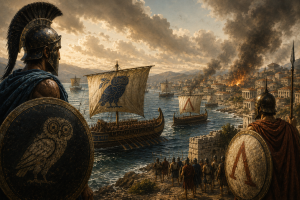
The Ionian War transforms the final years of the Peloponnesian War as Sparta and Persia discover that each needs the other: Sparta requires Persian silver to challenge Athens at sea, while Persia sees an opportunity to reclaim its influence over Ionia. With Athens weakened after the Sicilian disaster, revolts spread from Chios to Miletus as Alcibiades helps drive Sparta’s new strategy in the Aegean, opening the way for Tissaphernes and Darius II to forge the first Spartan–Persian treaty. Yet Athens is far from defeated, securing Samos, containing revolts on Lesbos, pressuring Chios and winning outside Miletus before withdrawing in the face of major Peloponnesian and Syracusan reinforcements. By the end of 412 BC, the war has entered a new and uncertain phase, with Persian gold, Spartan ambitions and Athenian resilience now shaping the struggle for control of the Aegean.